
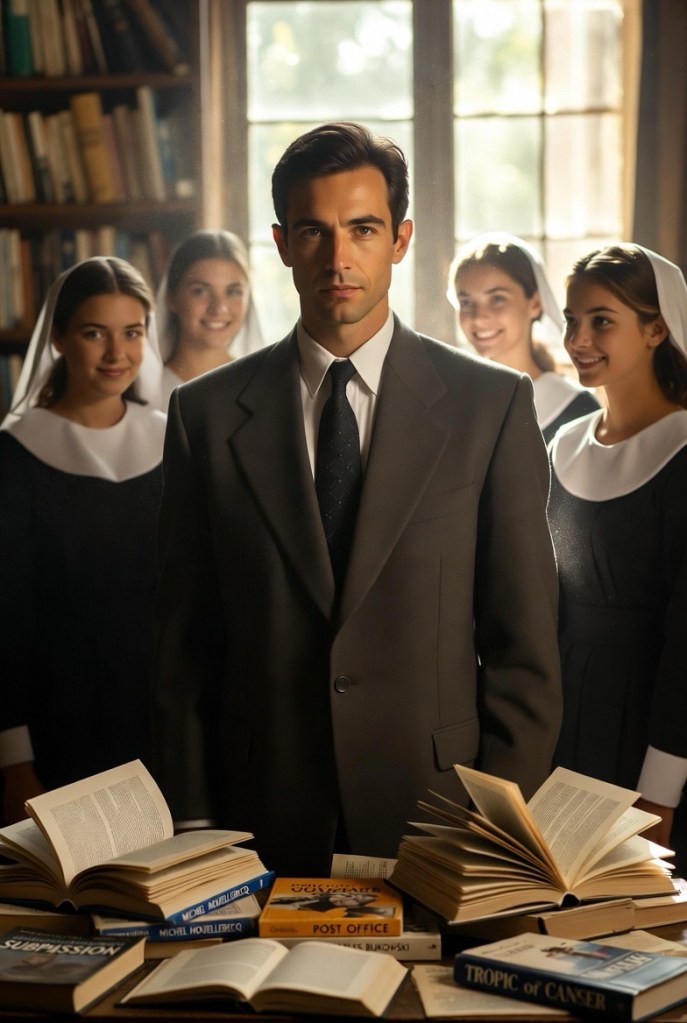
The girls unexpectedly materialized in his life. They kept inviting Elia to church on Sundays. Last summer, he went half-heartedly. He felt like an exotic bird. He wore a tailored suit and, briefly, felt handsome. Dust floated in the air; sunlight flooded the room. The music lacked a rhythm section, and one of the girls sat beside him. He was hypomanic, lost in private reverie. Otherwise, the liturgy would have been intolerable.
Now he was depressed. Getting out of bed felt impossible. He hadn’t been to church in half a year. It was winter—the darkest, most freezing period.
Mormon sincerity would have felt absurd in any other context. Was it a facade? He couldn’t quite take it at face value. Still, these people began to feel like harbingers of hope.
The juxtaposition was grotesque. Utah missionary girls, smiling with unsettling composure. He had bad tattoos and a lecherous past. Did they find him deplorable? He’d soaked his self-image in contempt, which caused difficulties in reading social cues accurately.
He practiced in the mirror:
“Hi. How’s life? You’re beautiful—sorry—what were you saying? Right. Perfect.”
Next time, he’d flirt. Girls like them must be starving for innocent banter.
What bothered him was the wall of politeness. Come on, guys—show some humanity, for God’s sake. He wanted a crack in the fortress. None appeared.
They embodied life done right. His generation had squandered the holiest principles, then trampled over them. He wasn’t envious—he was curious. Outside looking in. Why was he so uninvolved by nature? Maybe pride, the almost Luciferian intellect. He prided himself as a thinker. And you eat what’s put in front of you when it comes to Christianity.
Perhaps Mormons were humanity untouched by the general corrosion. Women guarded chastity. Men exercised restraint. Elsewhere, sex had become entertainment and commerce. Marriage was the only haven for sexual intercourse, he thought. Fucking was supposed to mean something.
Why modernity’s obsession with sex? At thirty-three, a man should have learned to control his impulses already. If anyone ought to know, he did. Unchecked, lust has you spinning your wheels. At worst, it breaks you. Sin—he believed—detached one from God.
Last summer, he made a private oath: no more hollow encounters. He’d save intimacy for whatever sacred union remained possible. Around the same time, semen retention began. Conserve the essence. Redirect it upward—sexual transmutation. Mystical nonsense or not, he liked the discipline. It shaped his loneliness. He kept a pen in his hand instead of a penis.
The realization that followed was inevitable. Elia’s desire wasn’t erotic. It was architectural. He didn’t want the bodies of Mormon girls—he wanted the moral order they represented. So he had to see them as sisters, plain and simple. Intimacy had to be more than nervous systems colliding. It was reserved for marriage. Most sex now was mere shared boredom. The sacrament had become a commodity.
His longest relationships had lasted half a year. Restlessness always won. Maybe a renewed value structure could make something last.
God, prepare me a wife—the mother of my children, he prayed silently.
His sister’s wedding marked a shift. He watched two people swear permanence and cried. The contrast with the zeitgeist was brutal. Culture worshipped disposability. Something ancient in him finally tightened. After that, the old irreverence toward sex vanished. His past made him queasy now. A new seed of holiness started to sprout.
Still, he couldn’t call himself Christian. Something resisted faith. Perhaps it was genetic. Twin studies suggested religiosity was heritable. Maybe he just lacked the receptors.
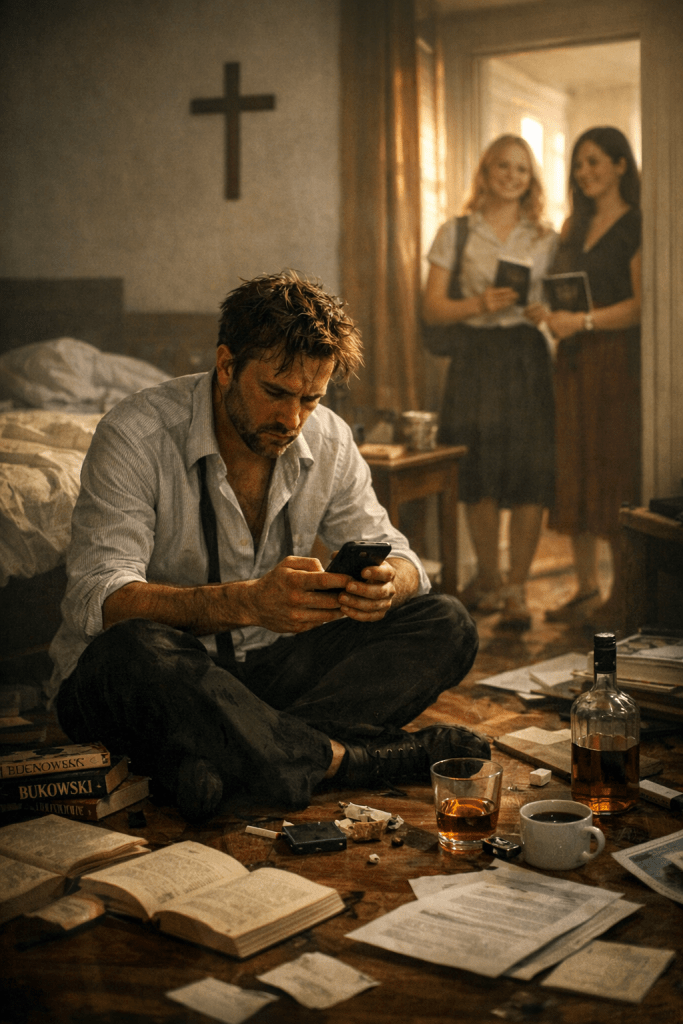
His appetite was gone. Some days, he barely ate. Caffeine and nicotine became the regimen. When he ate, it was protein and fat—just enough. Fasting felt natural. His body learned to burn itself. He felt sharp. Efficient. Anxiety lingered, but depression lifted. His output exploded—thousands of words in a sitting.
By day four, he was filthy. No shower. Skin itching. Hands sweating. He felt no shame—only curiosity. How feral could he become if left alone?
He typed without stopping. A doctor might have called it hypergraphia. Pages accumulated, unedited. If depression returned, he’d delete everything. Reference books lay open—Houellebecq, Bukowski, Miller. He moved among them like a patient in a ward he’d built.
Social contact became intolerable. A knock on the door would have been catastrophic. Elia felt hunted—by what, unclear. Isolation sharpened into animal terror.
Solitude had exhausted its usefulness. Beyond that, it clarified nothing. It merely preserved him. The writing continued, airless, produced in a closed system. Purity, pursued seriously, led not to elevation but to sterility. Returning to the world required compromise, embarrassment, and loss. He chose stillness to avoid others.
Elia achieved perfect stability—not contaminated by the world,
and with that, irrelevance.

 Eemu Julius